
IBM Schoolhouse
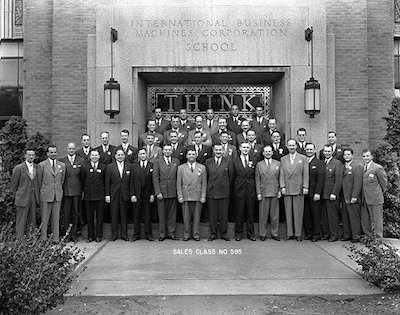
1933 Thomas J. Watson led his company through the Great Depression of the 1930s with much success. Implementing the IBM Schoolhouse along with other training facilities for his employees prepared them for the revival of the economy. Training was not the only thing incorporated into his company in the rough times, but also research; IBM released one of the finest research and development laboratories in the world. Through the implementation of research and training in the Great Depression, IBM developed into a very successful company.
George Stibitz's Ideas for a Relay Based Computer (Digital)
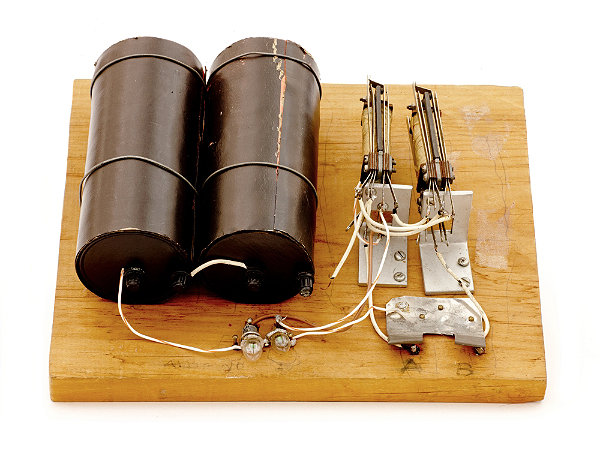
1937 Upon creating a circuit out of telephone relays, wires, a battery, and lights, George Stibitz demonstrated that one could create a computer that utilizes relays along with Boolean logic for calculations. A relay is simply an electrical switch triggered by a pulse of electricity; the fact that it is a switch allows it to direct electricity or not to other electrical components. The device he created was christened "Model K" beacause it was developed on his kitchen table. Although crude, the device showed proof of concept as a lit bulb indicated a binary value of "1" and an unlit bulb indicated a binary value of "0." Eventually, the concept progressed into a computer (Complex Number Computer) that was able to perform multiplication and division of complex numbers. Multiplying and dividing complex numbers, at the time, was a strenuous process at Bell Labs, so the development of the Complex Number Computer proved to be a boon. Researchers would access the computer remotely via teletypes; if you are familiar with computer terminals nowadays, an open terminal is often called a tty, a term derived from the teletype.
Code Breakers at Blethcley Park and the Enigma (Analog)
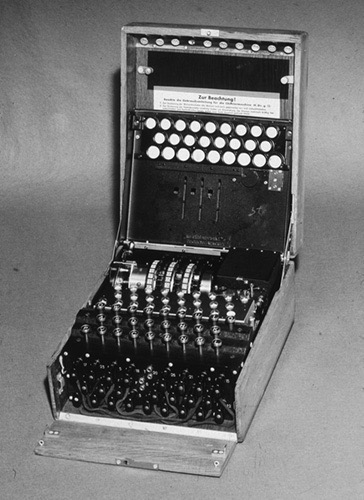
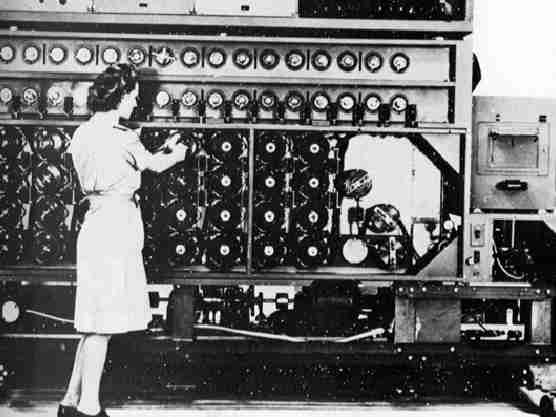
1940 During the breakout of World War II, the Germans began utilizing an encryption device known as Enigma. In order to encrypt a message with Enigma, one simply typed the message into the machine and then the machine would randomize the input based off the settings of the machine. The output would then be displayed in the lampboard. The settings of the Enigma could be adjusted through changing the order of the three rotors (6 permutations) and changing the plugboard wires and ports, which created a very large number of different possibilities for the way in which the Enigma would randomize the input of the operator. The encrypted message would then be sent via radio communication to other Enigma operators who had the same settings on their Enigmas as the Enigmas used for encryption. The receivers of the message would simply type in the encrypted message to see the actual message. The settings on every German Enigma would be changed periodically by the German operator, and changes were made sure to be communicated to all German-only operators of the Enigma. Therefore, it became increasingly difficult for a person to decipher an encrypted message by a German operator of an Enigma, for the person would need to know the correct setting for the Enigma. At Bletchley park (allied powers operation), codebreakers tirelessly worked at finding ways to decipher the encrypted messages. Notable codebreakers, Alan Turing and Gordon Welchman, designed an electro-mechanical computer called the Bombe. The Bombe was able to reduce the number of possible settings in which the Enigma encrypted a message. Proving to be very efficient, the Bombe was a huge success and led to the end of the war.
|
|
|---|
