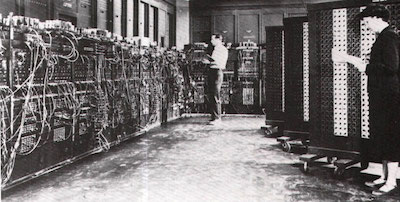
ENIAC (Digital)
1943 During World War II, ENIAC was under development through the United States. The computer's main purpose was to compute values for artillery range tables for the military. ENIAC was programmable; however, it used a plugboard for programming, so it was only programmable in a physical sense. Therefore, programming ENIAC often took much time. However, once the plugboard was set, calculations would run at electronic speeds. One feature of ENIAC that made it versatile was conditional branching, which allowed the computer to change the order of execution of a program based off a data value. One interesting aspect of ENIAC is that it utilized vacuum tubes. One of ENIAC's duties after the war was to perform calculations for the design of a hydrogen bomb.
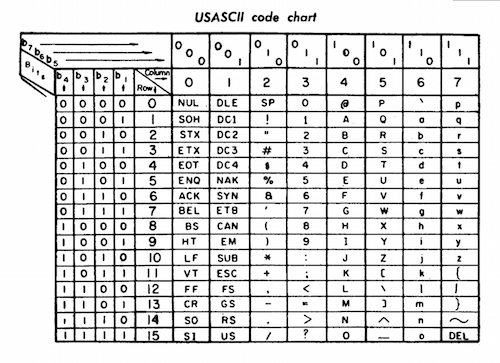
ASCII (Digital Concept)
1960 ASCII or American Standard for Information Interchange was a guide for the binary codes that correspond to characters on a keyboard and beyond. Since a computer can not simply read text that we humans are used to, it must use the language of binary to output the type of characters desired. ASCII used seven-bit numbers for the computer; in other words, each character would correspond to a binary number (0s and 1s) with seven values. For example, "i" would be "1101001" in binary. ASCII is still used today; however, UTF-8 has become the most popular character encoding system.
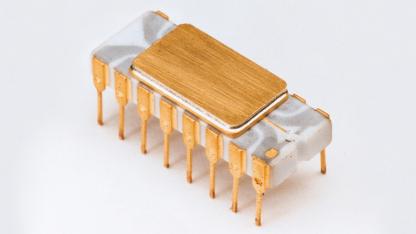
Intel's Microprocessor (Digital)
1970 Nippon Calculating Machine Corporation asked Intel for help in its printing calculator. Intel responded with a solution of four chips. One of the four chips was the Intel 4004 processor. The four chips were combined to create the MCS-4. Eventaully, Intel purchased the rights from Nippon Calculating Machine Corporation to establish the Intel 4004 processor along with the other chips as its own. The microprocessor had the same power in computing as ENIAC, having 2,300 transistors. Mentioning transistors, it should be noted that the number of transistros on an integrated circuit double approximately every two years; this is Moore's Law.